

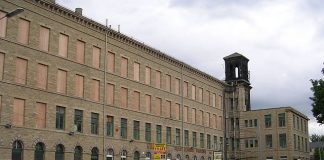
A major industrial development in Bradford has been refused due to concerns over a loss of woodland and brambles.
An application to build 17 industrial units on an area of land next to Legrams Mill was submitted to Bradford Council late last year.
The development would have created 5,220 square metres of new employment space, according to applicants Dadibhais Ltd, who cited a “chronic shortage” of such industrial, storage and distribution units in the city.
But planning officers have now refused the scheme, describing it as “unacceptable” due to the loss of vegetation and biodiversity on the site.
The long empty site between Legrams Lane and Woodhead Road has been subject to several redevelopment plans in the past.
Applications for a mixed development of shops and business units, and another for 66 flats and four shops have been approved – but development has never materialised.
The latest application said: “It is clear that the site detracts from the visual amenity of the area.”
It said the land had been empty for decades, and most recently subject to fly tipping and anti-social behaviour.
But despite the run-down appearance of the site, Council officers claimed the site still provided important biodiversity in the inner-city area.
Under current planning policies, Bradford Council requires all major development to lead to a “net-gain” in biodiversity, meaning that after the land is developed there is more biodiversity than before.
This policy has seen bat and bird boxes attached to many recent developments, as well as sections of site set aside for grassland or tree planting.
If developers cannot provide these improvements on the site, they are required to fund biodiversity improvements elsewhere.
On this latest application, biodiversity officers on the Council said: “We object to this application due to an unacceptable loss of habitats and the corresponding loss of biodiversity units with no proposals for appropriate mitigation or compensation for those losses or for providing a net gain for biodiversity.
“The Ecological Impact Assessment shows that the development will result in the loss of bramble and mixed scrub, other neutral grassland and broadleaved woodland.”
Officers said the development as it stands would lead to a 67 per cent loss of biodiversity units on the site, and “will result in the loss of 1,445m2 of broadleaved woodland.”
Another reason given for refusal was the “inadequate information in the plans with regards to the location of disabled parking spaces, short and long stay parking facilities, motor cycle spaces and EV charging spaces.”


