

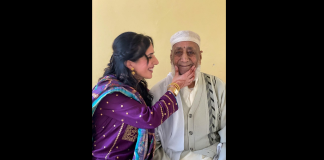
“His message is clear: war is insanity. The way forward is education, compassion and understanding between cultures.”
Victory in Europe Day, marked every year on 8 May, commemorates the official end of the Second World War in Europe. It is a day of remembrance and reflection, but also one of unity—an opportunity for communities across the UK to come together to honour the sacrifices made in the pursuit of peace.
For South Asians in Britain, VE Day holds a deeper significance. It is a reminder of the millions of men from the Indian subcontinent who served in the British Army, Air Force, and Navy during World War II. From the jungles of Burma to the deserts of North Africa, their contributions—both military and financial—were instrumental in the Allied victory.

Among these unsung heroes is Mirza Khan, now residing in Bradford and preparing to celebrate his 103rd birthday. His remarkable story is shared by his son, Amjad Pervez, to ensure the next generation understands the gravity of what their forebears endured.
“We must remember those that fought and say thank you. We must also pass the torch of the values they stood for—courage, unity, and the fight against extremism.” – Amjad Pervez
Mirza Khan was born on 24 May 1922 in Baramulla, Kashmir. His early life was shaped by political turmoil, leading his family to settle in Jhelum, Punjab. At just 16 years old, Mirza enlisted in the British Indian Army and was immediately deployed to serve.
He was stationed in Burma, where he became part of the mule trains responsible for transporting ammunition to the frontlines. One story in particular has stayed with his family: during one mission, a Japanese fighter plane spotted him. The pilot began a dive, poised to attack, but then pulled away at the last second. “For some reason, the pilot took mercy and did not fire,” recounts son Amjad. “We are forever thankful for that moment—he has lived to see 100 and beyond.”
After the war, Mirza answered the call once more—this time to help rebuild Britain. Along with thousands of others, he accepted the invitation from the British government to migrate and contribute to the country’s post-war recovery.
“They didn’t just help win the war, they helped rejuvenate the economy. Without their contribution, the UK would not have recovered the way it did.” – Amjad Pervez

In Bradford, Mirza worked as a senior railwayman, in textile mills, and later in a scrapyard. He embodied the resilience and dedication of a generation that sacrificed personal comfort for the betterment of their families and their adopted homeland.
Now the patriarch of a large family—father to seven children and grandfather to 30—Mirza’s legacy is woven into the fabric of Bradford. His descendants include business owners and professionals, all inspired by his values of honesty, hard work, and generosity.
Amjad notes that, like many veterans, his father rarely spoke of the traumas of war. “War veterans often stay silent about what they witnessed. And despite their bravery, many Indian soldiers were discriminated against—given poor conditions, unequal pay, and little recognition.”
Yet, Mirza remains philosophical: “He is a forgiving man. He believes life must go on.”
Amjad reflects on the deeper philosophy passed down by his father: “He understood that humanity is one. Regardless of colour or creed, when you’re wounded, you bleed the same. Those who seek to divide us are the real enemies—not ordinary people who want peace.”
Mirza Khan’s life is a powerful reminder that freedom has come at a cost—and that cost was paid not just by the British but by people from across the Empire. His story urges us to remember the role of South Asian soldiers in the war effort, and to challenge the narrative that often excludes them from British history.
“His message is clear: war is insanity. The way forward is education, compassion and understanding between cultures.”
In his final thoughts, Amjad shared his father’s concern about ongoing global conflicts: “He’s mortified by the situation in Gaza. He believes the same values that fought fascism should be used today to speak out against injustice.”
Mirza Khan’s story is not only a tale of survival but of contribution, courage, and a deep commitment to unity. As VE Day approaches, let us ensure that heroes like him are never forgotten.


