

A pioneering project at the University of Bradford is using immersive technology to help people with dementia reconnect with their past and improve their wellbeing, by surrounding them with images, sounds, and memories of the city they call home.
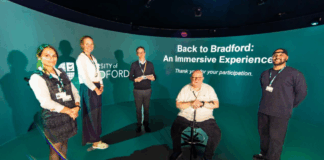
The initiative, titled ‘Back to Bradford: An Immersive Experience,’ invites participants into the University’s seven-metre iGloo, a 360-degree projection dome where historic and modern scenes of Bradford come vividly to life. The aim is simple but powerful: to use sight, sound, and memory to rekindle emotional connections, trigger conversation, and bring comfort to those living with dementia.
Stepping back in time, in 360 degrees
Inside the iGloo, visitors are surrounded by panoramic footage of Bradford through the decades, from a blue trolleybus gliding down the high street to steam trains pulling into Haworth Station, and even the 1973 demolition of the city’s original Kirkgate Market.
There are glimpses of Odsal Stadium in its rugby heyday, Shipley Glen Tramway, and sweeping views of Roberts Park in Saltaire. Each image has been carefully chosen for its familiarity and emotional resonance.
Michael Andrews, who was diagnosed with a rare form of dementia called Posterior Cortical Atrophy in 2017, took part in the first sessions.
“The photograph of the Bradford riots brought back memories for me,” he said. “It’s a good project for people with dementia and it will help to bring back memories for the older generation. I enjoyed seeing the older images of Bradford.”
Science meets storytelling
The project is led by Dr Ana Barbosa, Senior Research Fellow at the University’s Centre for Digital Innovations in Health and Social Care, who is studying how immersive environments can improve mood, cognition, and social engagement for people with dementia.
“Reminiscence is a well-known therapy, but the use of immersive technologies for this purpose hasn’t been widely explored,” said Dr Barbosa.
“The iGloo allows us to surround participants with familiar places and moments, stimulating memory and emotion in a very natural way. It’s about using digital innovation to promote wellbeing, not just for people with dementia, but for other vulnerable populations too.”
Participants’ responses are being recorded using eye-tracking technology, audio discussion, and interviews, helping researchers to understand how immersive environments can aid emotional health.
Technology with heart
Erica Bellamy, the University’s Director of Digital Health and Social Care, says the project shows how technology can build bridges rather than barriers.
“Immersive experiences like this connect people to their memories, their communities, and each other,” she said. “By stepping into familiar places through digital projection, participants experience joy, reflection, and connection. It’s a powerful reminder that innovation and compassion can go hand in hand.”
Hasnehn Haider, the University’s Immersive Learning Lead, helped capture the 360-degree footage.
“From Haworth to Saltaire and into the city centre, these are places people know and love. Dovetailing the past with the present gives the experience real depth,” she said.
The iGloo was originally installed as part of an Arts & Humanities Research Council investment supporting Bradford’s City of Culture programme. It is one of the first UK installations to offer full 360-degree floor projection, creating an ultra-realistic sense of immersion.
Professor Andrew Wilson, Chair in Forensic & Archaeological Sciences, added: “The iGloo was designed as a visualisation tool for research and public engagement. This project shows how cross-disciplinary collaboration, combining archaeology, health, and digital technology, can transform lives.”
More than memory
The University of Bradford says the project reflects its mission to use digital innovation for social good, connecting research with real-world impact.
“This is about much more than memory,” said Dr Barbosa. “It’s about dignity, inclusion, and belonging. When people recognise a street or a building from their past, their faces light up, that’s the real magic of technology used with purpose.”


