


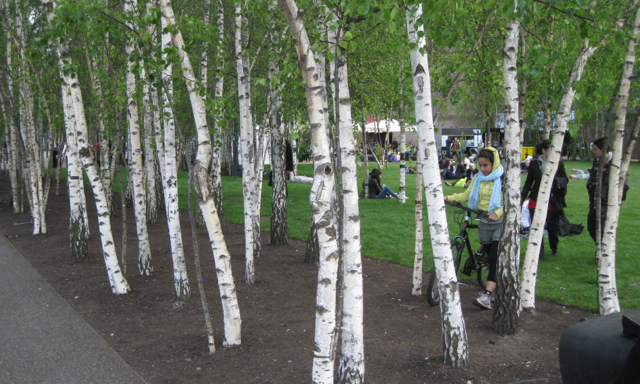
London, a city known for its bustling roads, enormous skyscrapers and overwhelming streets, is now going through a surprising transformation.
London can now be called a forest!
According to the UN definition, a forest is “land spanning more than 0.5 hectares with trees higher than 5 metres and a canopy cover of more than 10 per cent, or trees able to reach these thresholds in situ”, a benchmark London meets with ease.
More than 553,000 trees have been planted by London boroughs since 2019 as councils seek to tackle climate change, improve biodiversity and make neighbourhoods more resilient to extreme heat. This large scale planting programme follows climate emergency declarations made in 2019.
Data obtained from councils through Freedom of Information (FOI) requests shows that at least 553,621 trees have been planted across the capital in recent years. Enfield recorded the highest number, planting 129,389 trees since declaring a climate emergency in 2019.
Much of that work has centred on the borough’s ambitious Enfield Chase restoration scheme, described by the council as London’s largest woodland and nature restoration project. The initiative aims to create new woodland, wetlands and habitats for wildlife while increasing tree cover across the area.
Other outer London boroughs also recorded significant planting numbers. Barking and Dagenham planted almost 120,000 trees, while Hillingdon reported more than 61,000 and Waltham Forest more than 37,000.
The figures come as climate experts warn that rising temperatures are becoming an increasing challenge for urban areas. As much as planting trees sounds relieving, it does not translate into the problem being solved.
“Planting more trees isn’t enough. We need to plant them in the right places,” said Carolyn Axtell, Kerbside Greening Manager at climate charity Possible.
She said: “A few weeks ago, London hit 35 degrees in May. This week we expect to see 39 degrees. That kind of heat makes being outside genuinely dangerous.”
“Trees are one of the simplest tools we have for reducing temperatures. They cool streets by up to 12 degrees, provide shade, and make cities actually liveable.”
Therefore, the placement of trees matters as much as planting them.
Axtell argued that some of London’s hottest and most deprived neighbourhoods often have the least tree cover and called for more investment in “kerbside greening” projects to ensure all communities benefit from cooler and greener streets.
While larger outer boroughs have generally recorded the highest planting figures, the same is not possible in the inner parts of London. Authorities face greater challenges when planting trees in the inner city due to limited space and dense development.
Despite being one of London’s smallest boroughs, Hammersmith and Fulham says it has planted around 15,000 trees since 2019. The council has also developed several “Tiny Forests” as part of its environmental programme.
On the other hand, Kensington and Chelsea has also continued planting despite space constraints. The borough, London’s smallest local authority area, already has more than 7,500 street trees.
Though disparities exist in planting figures, the data shared through FOI requests at least shows the efforts made by councils to make the city more breathable, cleaner and greener. A change that is particularly important as the UK continues to face climate related challenges during ongoing heatwaves.
It was only in today’s UN assembly, UN chief Antonio Guterres said, “London isn’t just calling. It’s cooking,” addressing UK heatwaves. Amid this, it will be critical to see how much London’s future can be improved through these environmental projects.
Article updated by Yashvi Jain


