

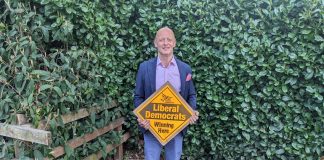
This piece is part of a series of interviews with local party leaders across Leeds ahead of the local elections on 4 May.
Leeds’ Liberal Democrats have claimed the city’s ruling Labour administration “isn’t listening”, as it fights for votes in next month’s local elections.
Lib Dem group leader Stewart Golton said his party had a strong track record in “speaking truth to power” in the areas of the city his councillors represent.
In an interview ahead of May’s polls, Councillor Golton accused Labour of starving the suburbs of cash to fund new city centre infrastructure and suggested Leeds had “nothing to show” for its flagship Year of Culture so far.
“Labour’s not listening,” Councillor Golton, whose party is fielding candidates in all of the city’s 33 wards and defending three seats, said.
“There’s a certain entitlement to the Leeds Labour group. They think they’re the only people worth listening to and that they’re the only ones where any creativity can come from.”
Councillor Golton cited his recent motion calling for a second homes tax to be introduced in Leeds, which was rejected by the ruling party, as “symptomatic” of this perceived approach.
In recent months, the council has U-turned on proposals to bring in parking charges at parks and green spaces and on its plans to close Queensway School in Yeadon. Both ideas had been strongly opposed by Lib Dems and other opposition councillors, as well as members of the public.
Asked if this suggested Labour was listening more than he claims, Councillor Golton said both examples were “the exception that proves the rule”.
“That’s why the council needs effective challenge and that’s where strong opposition is really valuable.”
Councillor Golton claimed Labour are running a “two speed city” and was critical of the traffic “gridlock” that city centre roadworks have caused in recent months.
The works themselves have been staunchly defended by the administration, who say they will deliver lasting improvements.
But Councillor Golton said: “Hundreds of millions of pounds is spent on the city centre, but what is the council’s policy for all the district and town centres elsewhere, where the majority of Leeds residents – who don’t participate in the nine-to-five economy in and out of Leeds city centre – spend most of their time?”
Liberal Democrats in numbers
Current seats on Leeds City Council: 7/99 (3rd largest party)
Number of candidates standing in 2023 local elections: 33 (out of 33 wards)
Year first Lib Dem councillor elected in Leeds (since council was reorganised in its present form) : 1973
Liberal Democrats candidates standing in your area
Adel and Wharfedale – Sharon Margaret Slinger
Alwoodley – Jonathan Jared Levy
Ardsley and Robin Hood – Tom Leadley
Armley – Dan Walker
Beeston and Holbeck – Peter Richard Andrews
Bramley and Stanningley – Elizabeth Anne Bee
Burmantofts and Richmond Hill – David Ewan Hollingsworth
Calverley and Farsley – Stuart McLeod
Chapel Allerton – Aqila Choudhry
Cross Gates and Whinmoor – Patricia Cooper
Farnley and Wortley – Christine Mavis Golton
Garforth and Swillington – Jake Knox
Gipton and Harehills – Mark John Twitchett
Guiseley and Rawdon – Robert Hugh Jacques
Harewood – Dan Cook
Headingley and Hyde Park – Brandon John Ashford
Horsforth – James Michael Spencer
Hunslet and Riverside – Benedict Luke Turner-Chastney
Killingbeck and Seacroft – John Otley
Kippax and Methley – Lesley Ann McIntee
Kirkstall – Adam James Belcher
Little London and Woodhouse – Katherine Mary Arbuckle
Middleton Park – Jude Patrick Arbuckle
Moortown – George Sykes
Morley North – James Trueman
Morley South – Mihai Marcelin Barticel
Otley and Yeadon – Ryk Downes
Pudsey – Christine Amy Glover
Rothwell – Diane Chapman
Roundhay – Darren Finlay
Temple Newsam – Keith Cecil Norman
Weetwood – Chris Howley
Wetherby – James Andrew Prince


