

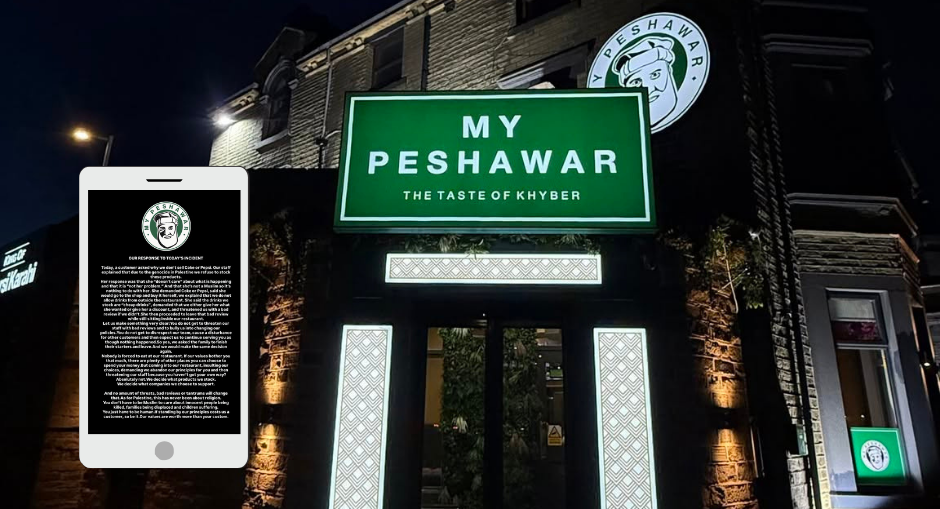
A Bradford restaurant has received thousands of messages of support after publicly defending its decision to refuse to stock Coca-Cola and Pepsi and asking customers to leave following a disagreement over the policy.
The restaurant took to social media following the incident, opening its statement with a firm message that it would not tolerate its employees being intimidated.
“We and our staff will not be bullied by anyone who disrespects our staff,” it said.
“Also, everyone has their own views, don’t disrespect someone for being on the right side of humanity.”
The restaurant then gave its account of what had happened earlier that day.
According to the business, a customer asked why Coca-Cola or Pepsi were not available.
A member of staff explained that the restaurant had made a conscious decision not to stock the brands because of its position on the conflict in Gaza and support for Palestinians.
The restaurant alleged the customer responded that she “doesn’t care” about what was happening, that it was “not her problem” and, because she was not Muslim, it had nothing to do with her.
The disagreement then escalated.
According to the restaurant’s account, the customer said she would go to a nearby shop and purchase Coke or Pepsi herself.
Staff told her the restaurant did not permit customers to bring their own drinks onto the premises.
The restaurant claimed the customer then described the alternative soft drinks it stocked as “cheap drinks”, demanded either the drink she wanted was offered at a discount, and threatened to leave a negative review.
It said she subsequently posted the review while still sitting inside the restaurant.
That was when the business decided the disagreement had gone beyond a customer simply being unhappy with the drinks menu.
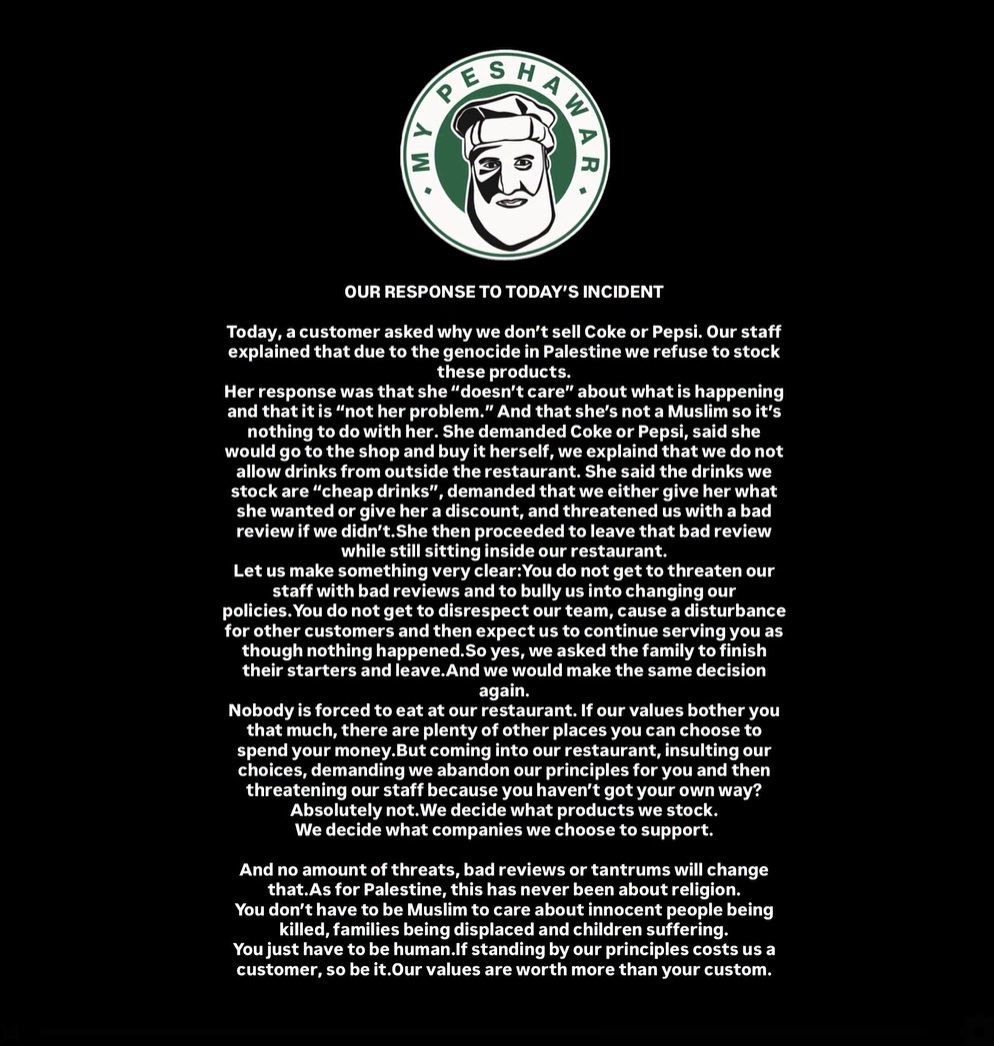
“You do not get to threaten our staff with bad reviews and to bully us into changing our policies,” the restaurant said in its statement.
“You do not get to disrespect our team, cause a disturbance for other customers and then expect us to continue serving you as though nothing happened.”
The family was asked to finish the starters they had already been served and leave the restaurant.
It is a decision the business says it does not regret.
“So yes, we asked the family to finish their starters and leave… and we would make the same decision again,” its statement continued.
“Nobody is forced to eat at our restaurant.
“If our values bother you that much, there are plenty of other places you can choose to spend your money.”
The restaurant went further, arguing that while customers were entitled to disagree with its position, they were not entitled to demand that a business change the products it chose to sell.
“We decide what products we stock. We decide what companies we choose to support. And no amount of threats, bad reviews or tantrums will change that.”
It also rejected the suggestion that its stance on Palestine was an issue exclusively for Muslims.
“As for Palestine, this has never been about religion,” the statement said.
“You don’t have to be Muslim to care about innocent people being killed, families being displaced and children suffering. You just have to be human.”
And the restaurant ended with perhaps its strongest declaration:
“If standing by our principles costs us a customer, so be it.
“Our values are worth more than your custom.”
The response online has been substantial.
Thousands of people have liked the restaurant’s statement, while its comments section has been flooded with messages supporting the business for standing by its position and defending its staff.
Many praised the restaurant for refusing to allow the threat of a poor online review to dictate its policies, with supporters repeatedly expressing “respect” for the stance it had taken.
But the incident also opens a much wider conversation about the increasingly complicated position independent restaurants can find themselves in when global political and humanitarian issues arrive at the dining table.
Boycotts reach Bradford’s restaurant tables
The Bradford restaurant is not alone in deciding that the brands behind the drinks it sells, or refuses to sell, can reflect the values of the business itself.
Since the war in Gaza began, a number of restaurants, takeaways, retailers and consumers in Britain and internationally have stopped buying particular brands as part of pro-Palestinian boycott campaigns.
Coca-Cola has been among the most prominent targets.
Campaign groups including the Palestine Solidarity Campaign have called on shops, restaurants and consumers to boycott Coca-Cola products. Campaigners point particularly to the operation of a regional distribution centre by Coca-Cola’s Israeli franchisee in the Atarot Settlement Industrial Zone in occupied territory.
Coca-Cola has previously rejected claims that it supports any country, government or political cause through its business operations.
The boycotts have nevertheless had an impact in some markets, with international reports documenting falling sales of Coca-Cola and other major American brands in areas where Gaza-related consumer boycotts have gained significant support.
Bradford has seen that debate play out particularly visibly.
Several restaurants and food businesses across the Bradford district have chosen not to stock Coca-Cola, Pepsi or other brands targeted by campaigners, replacing familiar drinks with alternative cola and soft drink brands.
But Bradford has also previously seen the opposite side of the argument.
In 2024, serious disorder broke out outside Salah’s takeaway on Leeds Road following a dispute connected to calls for the business to boycott Coca-Cola.
The incident demonstrated why the principle of choice has to work both ways.
Just as a restaurant should not be intimidated into stocking a product it has chosen to boycott, a business which decides to continue selling a legal product should not face intimidation for doing so.
And customers, equally, remain free to decide where they spend their money.
When principles meet customer service
That is what makes the latest incident more complicated than an argument over a bottle of Coke.
For generations, one of the most repeated rules of hospitality has been that “the customer is always right”.
But is that still true when what the customer wants conflicts directly with a business owner’s ethical beliefs?
Restaurants make decisions about what they will and will not serve every day.
Some refuse alcohol for religious reasons.
Others serve only halal or vegan food.
Businesses increasingly make decisions around sustainability, animal welfare, local sourcing or environmental impact.
A restaurant choosing not to sell Coca-Cola or Pepsi could argue it is simply exercising the same commercial freedom: deciding which suppliers and products it wants associated with its business.
A customer, however, may see things differently.
When people pay to eat in a restaurant, they expect choice, hospitality and good service. They may not necessarily expect the political, religious or ethical beliefs of its owners to influence what is available on the menu.
There is also a commercial reality.
Refusing to stock globally recognised brands can mean losing customers who specifically want those products.
Taking a public position on an issue as divisive and emotionally charged as Israel and Palestine can potentially alienate customers whose views differ, or customers who simply do not want politics to form part of their dining experience.
Independent restaurants therefore face a difficult calculation.
Should customer demand determine what goes onto their shelves?
Or should the people who own those businesses be entitled to decide that there are some sales they are prepared to lose?
There is another dimension which has become increasingly important to restaurants: online reviews.
A single disagreement which might once have ended when a customer walked through the door can now immediately become a one-star Google review, TikTok video, Facebook post or Instagram story.
For independent businesses whose reputations can depend heavily on online ratings, that gives customers considerable power.
Restaurants must be accountable when food or service falls below reasonable expectations.
But businesses increasingly question whether the threat of a negative review is sometimes being used as leverage during disputes over discounts, refunds or policies.
In this case, the Bradford restaurant clearly believes that line was crossed.
Its position is that a customer was entitled to dislike its drinks selection and entitled to eat somewhere else, but not to pressure staff into changing a business policy through the threat of a damaging review.
And therein lies the debate.
A restaurant is a commercial business. It needs customers to survive.
But it is also owned and staffed by people who may have deeply held beliefs about events happening beyond Bradford.
For this restaurant, at least, the answer is clear.
It is prepared to lose custom rather than sell products it has decided it does not want on its premises.
Its statement leaves little room for doubt:
“Our values are worth more than your custom.”
But what do you think?
When a restaurant takes a stand on an issue its owners feel strongly about, should customers respect that decision and choose somewhere else if they disagree? Or, when you are running a hospitality business, should the needs and choices of the customer come first?


