


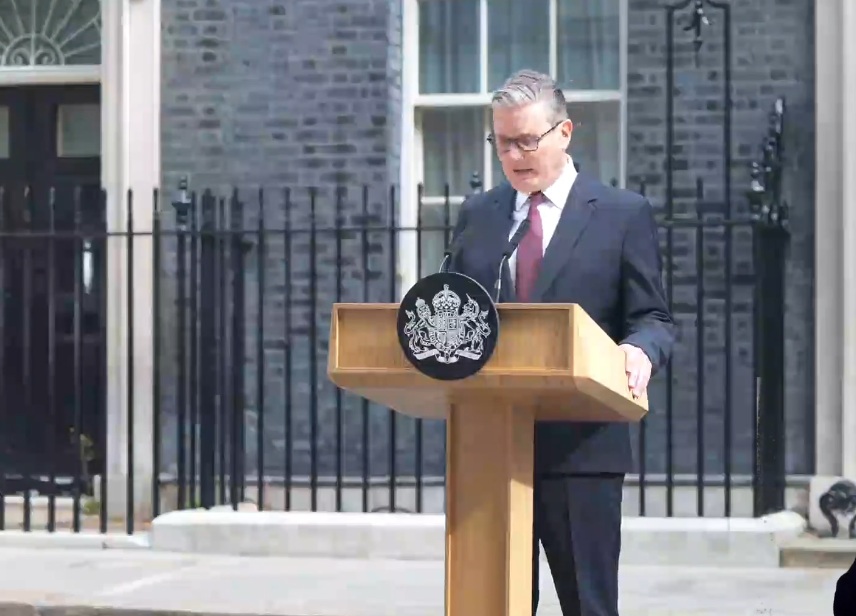
Prime Minister Sir Keir Starmer has announced he will resign as leader of the Labour Party, triggering a summer leadership contest and bringing an abrupt end to his tenure at the top of British politics.
In an emotional address from Downing Street, Sir Keir said he had listened to the views of Labour MPs and accepted that he was no longer the person best placed to lead the party into the next General Election.
Speaking outside Number 10, the Prime Minister reflected on his journey from rebuilding Labour after its 2019 election defeat to securing a landslide victory that returned the party to power after 14 years in opposition.
“Every decision I have taken has been about putting the country I love first,” he said. “That is why I will resign as leader of the Labour Party.”
Sir Keir revealed he had informed King Charles III of his decision earlier in the day and confirmed he would remain Prime Minister until a new Labour leader is elected.
The resignation marks a dramatic moment in British politics, ending a period that Sir Keir described as one of significant reform and national renewal.
During his speech, he highlighted what he regarded as the major achievements of his government, including economic growth, rising wages, increased investment, reductions in NHS waiting lists, enhanced workers’ rights and increased defence spending.
He also pointed to progress on immigration, social media protections for young people and measures aimed at reducing child poverty.
“Our reputation in the world restored,” he said. “With Britain once again standing up for decency, respect and the rule of law.”
Sir Keir used the speech to reflect on his leadership of Labour, recalling how he inherited a party he described as “politically, financially and morally bankrupt” following its crushing defeat in 2019.
He argued that Labour’s return to government had only been possible because of fundamental changes within the party, including efforts to tackle anti-Semitism and restore public confidence in its economic and national security credentials.
The Prime Minister acknowledged, however, that while questions about Labour’s ability to return to power had been answered, a different question now faced the party.
“The question my party is asking now is whether I am best placed to lead us into the next General Election,” he said. “I have heard the answer of my parliamentary party to that question. And I accept that answer with good grace.”
Under plans outlined by Sir Keir, Labour’s National Executive Committee will begin the process of electing a successor, with nominations opening on 9 July and the contest expected to conclude before Parliament returns from its summer recess in September.
The timetable is designed to ensure an orderly transition and avoid prolonged uncertainty at the heart of government.
Sir Keir pledged his “full and unequivocal support” to whoever succeeds him, saying they would inherit a country stronger and fairer than the one he entered office to govern.
He also thanked Labour colleagues, Downing Street staff and civil servants for their support and dedication throughout his leadership.
The announcement is expected to trigger intense speculation over who will emerge as Labour’s next leader and Britain’s next Prime Minister.
With Labour still in government and commanding a parliamentary majority, the outcome of the leadership contest will determine not only the future direction of the party but also the leadership of the country.
As the race to succeed Sir Keir begins, attention will now turn to the candidates seeking to shape Labour’s next chapter and secure a second term in office. Could Andy Burnham, who recently won a seat in parliament become the next UK Prime Minister?


