

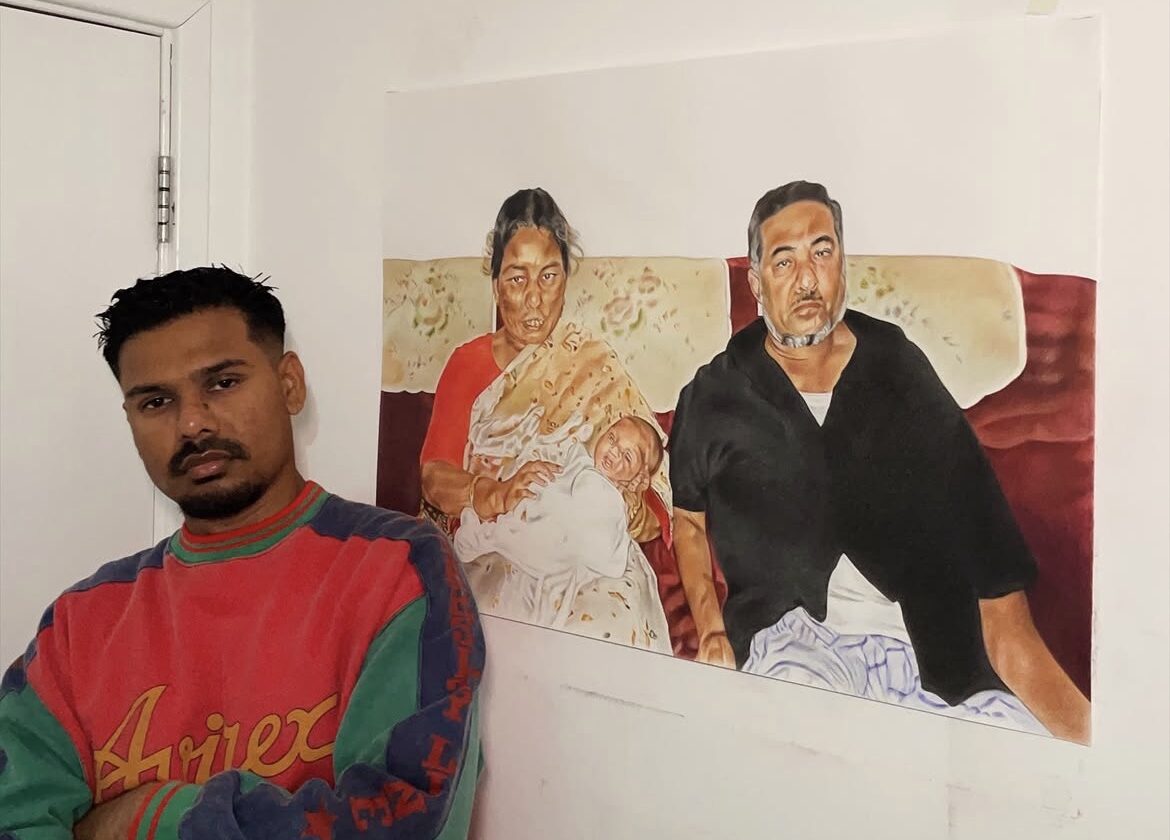
Every family has photographs that capture moments in time but leave questions unanswered. For East London artist Sameer Qureshi, revisiting his mother’s old photo albums became an opportunity to understand the lives his parents and grandparents lived before he was born and the legacy, they left behind.
That journey is at the heart of ‘The Ones That Came Before Me’, his first solo exhibition at Poplar Union, where painstaking coloured-pencil drawings recreate treasured family photographs documenting his family’s journey from Sylhet, Bangladesh, to Tower Hamlets.
But this isn’t simply an exhibition about migration. It’s about memory, family and the quiet moments that shape our lives. The photograph that changed everything wasn’t a dramatic moment of migration or celebration. It was a picture of his mother as a teenager.
“I saw my mum as a teenager in her school environment with her friends in their uniforms,” Qureshi said. “It was something I’d overlooked many times. It made me forget that she had a life before me.”
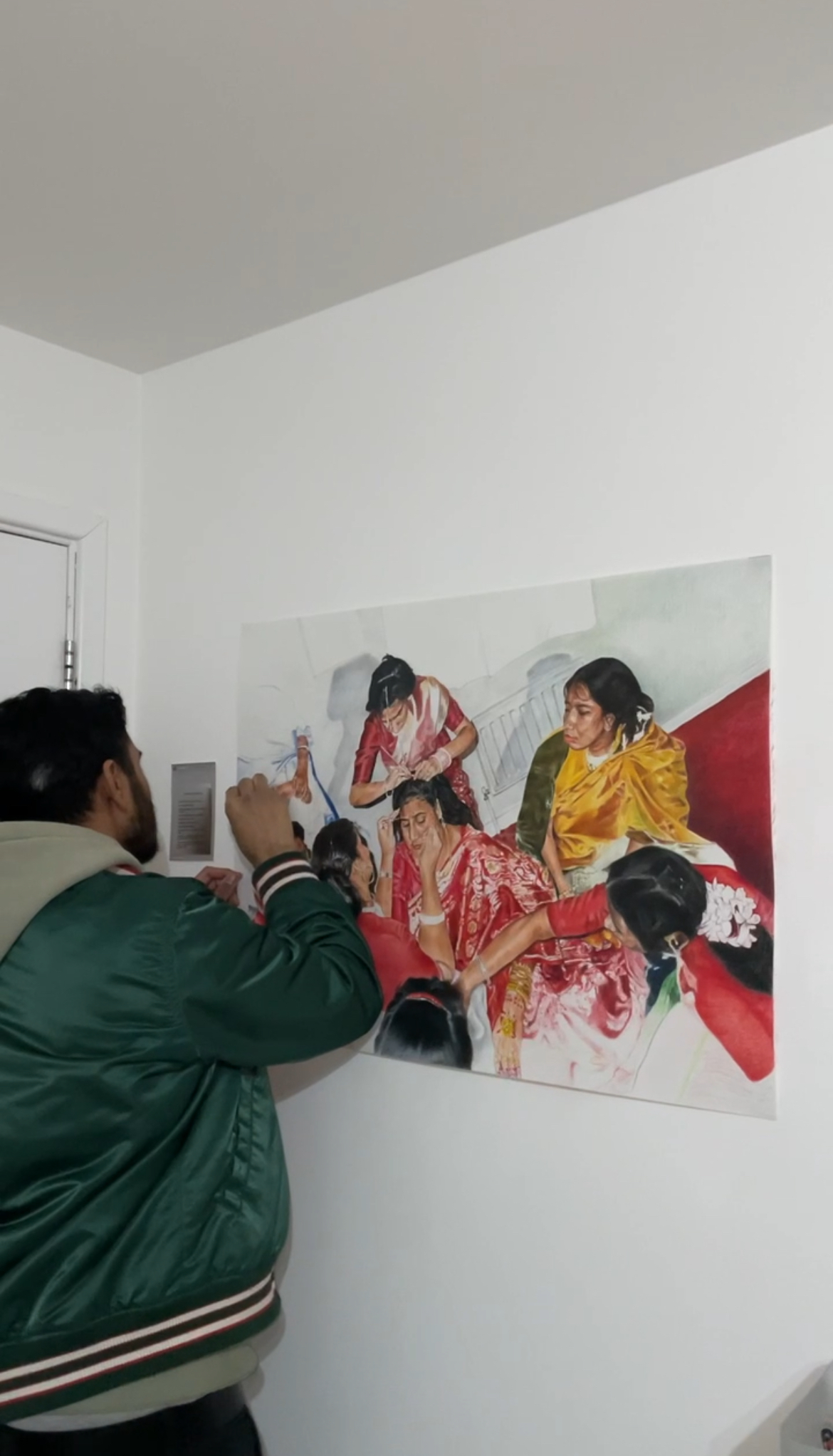
That realisation became the emotional starting point for the exhibition. Rather than enlarging or displaying the original photographs, Qureshi chose to redraw everyone by hand using coloured pencils, a process that took months of patient observation.
In a world where thousands of photographs are captured and forgotten every day, he deliberately chose the slowest possible way of looking.
“As much as I love seeing the photographs, I knew the way in which I draw would evoke emotions that you can’t experience just by looking at a photo,” he explains. “I spent two years drawing my mum’s portrait. I know that will make people see things differently. Your kind of forced to examine the details and extract the thoughts and emotions you need to.”
Drawing each image became far more than an artistic exercise. It became a conversation with the past. Hours spent studying familiar photographs encouraged him to ask questions he had never asked before, leading to unexpected reconnections with relatives and a deeper understanding of his family’s story.
“This project allowed me to get back in contact with my grandmother, my dad’s mother, who I hadn’t spoken to in decades,” he says. “We’d have two-hour phone conversations about what life was like for her in London and travelling the world. It was fascinating.
“It also made me realise my parents had their own lives before they had me. They were their own people. They were living in that universal dream of racing against time—get married by a certain age, get a job, start a family and everything will be fine.”
Although the exhibition centres on one family, its themes reach far beyond Qureshi’s own experience. For generations of Bangladeshi families who settled in East London, family albums have become unofficial archives, preserving stories that rarely appear in history books. They record birthdays instead of political milestones, family meals instead of headlines, and everyday life instead of grand historical events.
Those ordinary moments are precisely what interested Qureshi. Migration stories often focus on sacrifice, hardship and resilience. His drawings choose to celebrate something quieter: the joy of simply building a life.
“We live in a time where there is so much to consume on social media and we can easily get overwhelmed,” he said. “The faster the technology, the less patience we seem to have.
“I knew my artwork would break that routine, even if it only gets someone thinking for two minutes. I want people to pause and reflect on the cherished moments they had with their families growing up. I want that feeling of wholeness to come back.
“In a world that teaches us to rush and move on to the next thing instantly, I knew I had to include the quieter moments because it’s a universal experience.”
He believes those slower moments have become increasingly valuable.
“Our grandparents never had to see thousands of opinions flooding them every day,” he says. “They saw what they needed to see and then carried on with their day. They were more present. Work time was work time and family time was family time. I want to bring that essence of presence back.”
The drawings also revealed unexpected discoveries. Sometimes the people he thought he recognised weren’t who he believed they were.
“It’s funny because all this time I thought I was looking at a specific family member in one photograph, and it turned out it wasn’t them,” he said. “It got me thinking, ‘Who are they? And how have I never met them before?'”
For Qureshi, those unanswered questions are part of what makes family photographs so powerful. He believes they represent a side of Britain’s social history that official archives can never fully capture.
“Oh absolutely,” he said when asked whether family albums are overlooked historical records. “A lot of families are private and don’t want their intimate family moments to be seen on a larger scale.
“Even if they donated photographs to an archive, there would always be pictures that never leave the album because of their sentimental significance.”
Perhaps that explains why visitors from every background have connected with the exhibition. Although rooted in one British Bangladeshi family’s story, Qureshi hopes people don’t simply see his relatives but they also see their own.
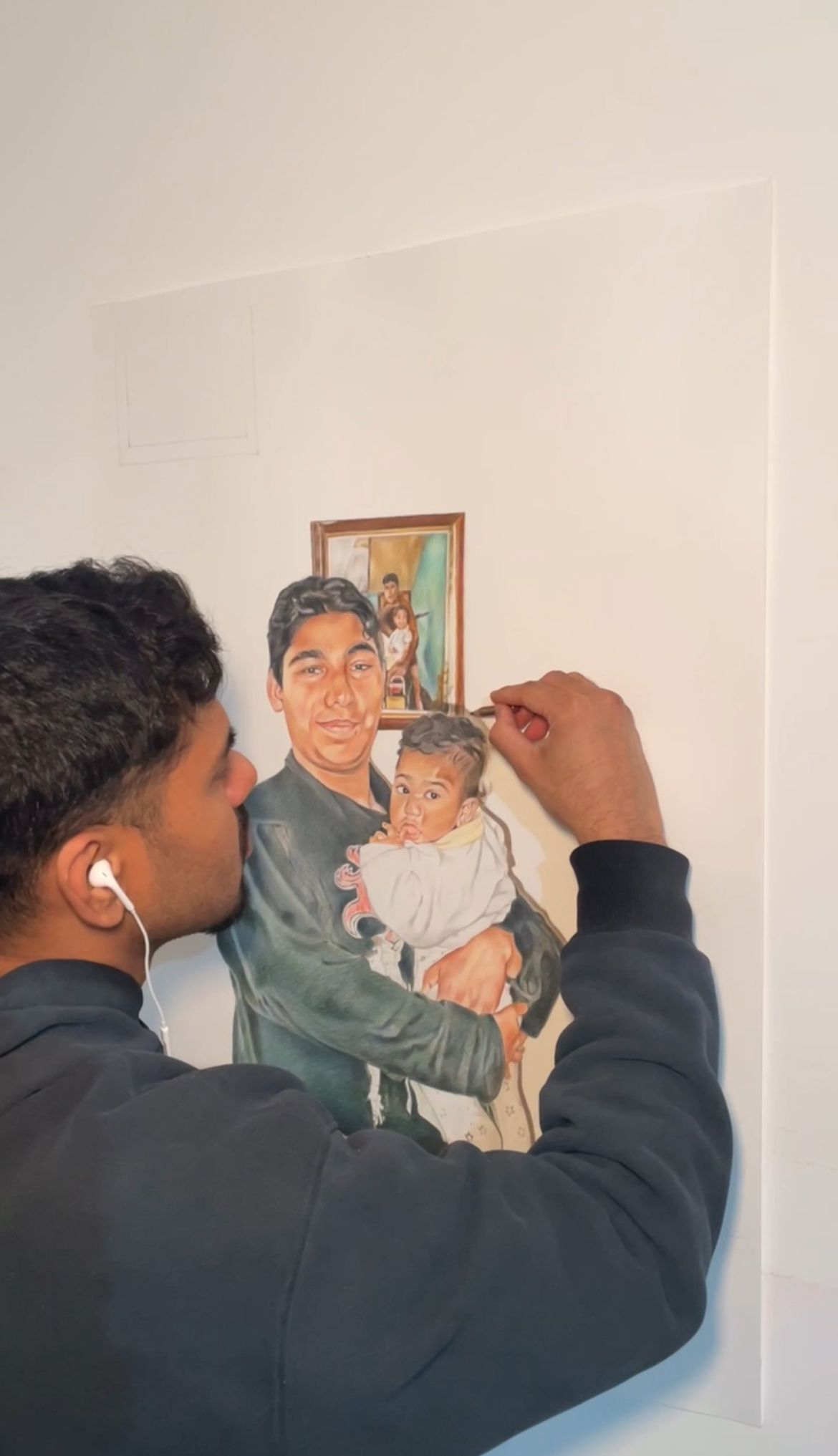
“Honestly, I want them to see themselves,” he said. “When they look at me as a baby, I want them to remember their earliest memory as a child. When they see my uncles, I want them to think of theirs. When they see my grandparents, I want them to be moved and strengthen that relationship if they’re still lucky enough to have them.”
The exhibition’s title, ‘The Ones That Came Before Me’, is both a tribute and a reminder.
Every generation inherits more than a surname. It inherits values, traditions and sacrifices that often go unspoken until someone takes the time to ask the questions. When asked what he hopes future generations of his own family will understand after seeing these drawings, his answer was simple.
“I hope they know we were real people with real stories,” he says. “We came from humble beginnings, whether we migrated to London or were born here. We worked hard on ourselves and tried to contribute something positive to the world and to our families.”
And perhaps the greatest inheritance isn’t something that can be photographed at all.
“I think it’s a strong moral foundation,” he reflected. “Sometimes that can seem boring, but it stops you making poor decisions. My family always tried to keep everyone close. They wanted everyone at family gatherings because that’s how relationships grow stronger.”
In preserving his family’s photographs, Sameer Qureshi has done more than create an exhibition. He has created a reminder that behind every old photo album is a history worth revisiting, and that sometimes, understanding where we’re going begins with taking another look at the people who came before us.


