

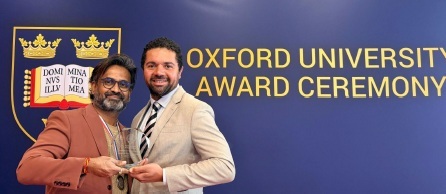
Artificial intelligence leader Shekhar Natarajan has been awarded the prestigious Bodleian Medal by Oxford University, recognising his contributions to advancing AI in the public interest.
The honour marks a defining moment for the founder and CEO of Orchestro.AI, whose work is reshaping how the industry approaches ethics, responsibility and human-centred innovation.
Natarajan has emerged as one of the most distinctive voices in AI — a technologist, inventor and entrepreneur challenging conventional thinking by placing human dignity, conscience and purpose at the core of technological development.
His journey to global recognition is one of resilience and determination. Raised in India, he was only able to continue his education after his mother pawned her wedding ring. He later moved to the United States with just $34, at times living in his car while navigating rejection and hardship.
Today, he holds more than 200 patents and has spent over two decades helping scale major global brands including Walmart, Coca-Cola, Disney and PepsiCo.
Through Orchestro.AI, Natarajan is pioneering what he calls “Angelic Intelligence” — a patented approach that embeds ethical reasoning into the foundation of AI systems, rather than treating it as an afterthought. His vision seeks not to replace human judgement, but to enhance it.
Speaking at Oxford, Natarajan reflected on the significance of the recognition.
“To stand in Oxford, a place that has shaped human knowledge for centuries, and receive the Bodleian Medal is something I could not have imagined,” he said.
“At this moment in history, as artificial intelligence becomes part of that legacy, we are not just building tools — we are redefining what it means to think, to know, and to act responsibly.”
His recognition comes at a critical time for the global AI sector, as debates around ethics, governance, bias and trust intensify. Natarajan’s work offers a clear direction — not by slowing innovation, but by redefining its purpose.
In an industry often driven by speed and scale, his approach stands apart: that the future of artificial intelligence must be built not only on intelligence, but on wisdom.


