


What began with a £3,000 research grant investigating the overcrowded living conditions facing Bradford’s ethnic minority communities has grown into a housing association managing more than 1,400 homes across the district.
Now, 40 years after it was established, Manningham Housing Association (MHA) has marked four decades of providing affordable homes to individuals and families, while setting out plans to build up to 150 more.

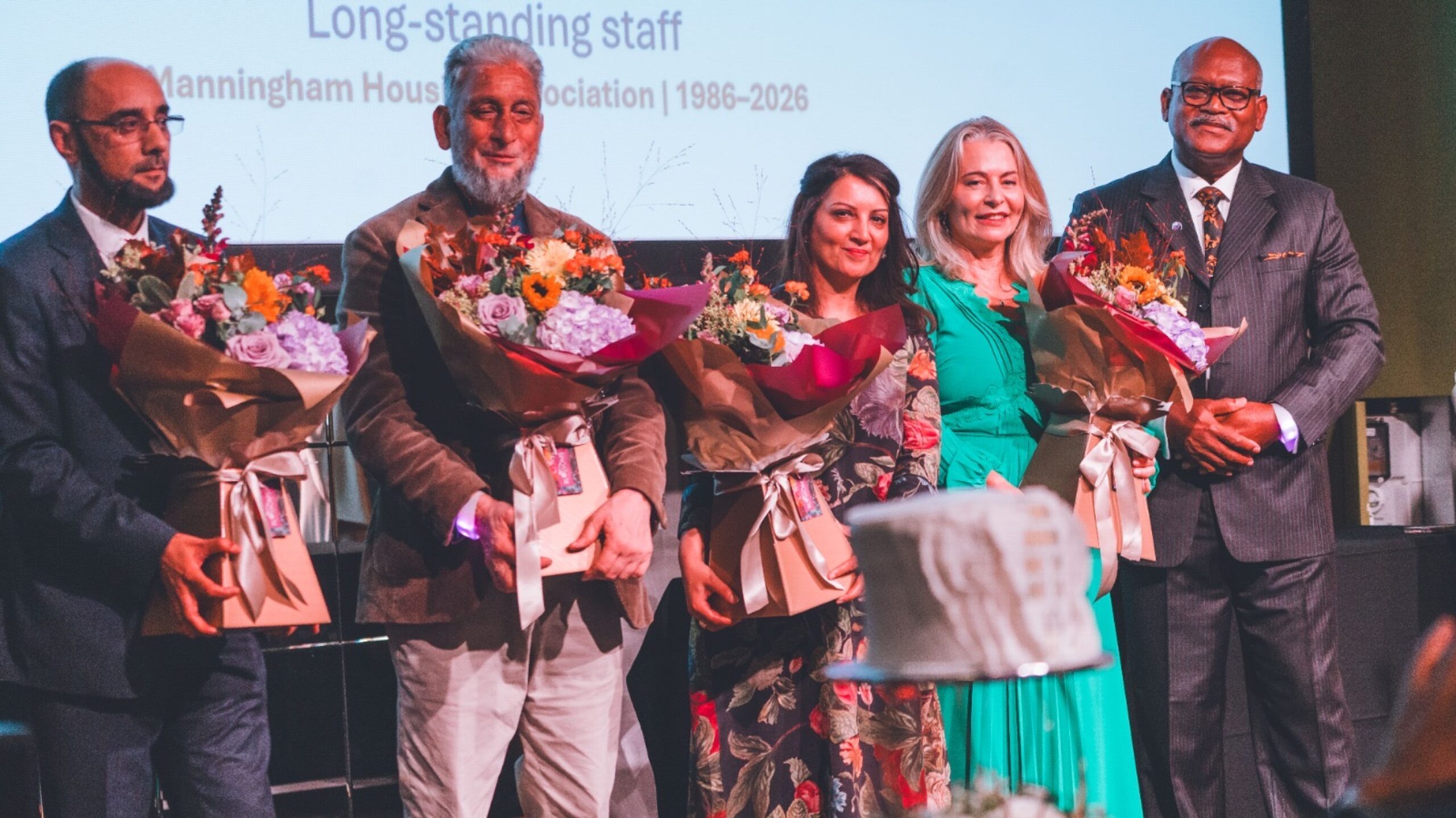
The association celebrated its 40th anniversary at Bradford Live, bringing together staff, residents, community figures and guests to reflect on an organisation whose roots can be traced back to the housing inequalities experienced by Bradford’s growing South Asian communities in the 1980s.
MHA was established in 1986 following a six-month research project carried out by Bradford’s Bangladeshi Youth Organisation.
At the time, some families in the district were living in severely overcrowded conditions, with reports of as many as 18 people sharing a single house.
Bradford Council required evidence of the housing need before investing in new provision and awarded the Bangladeshi Youth Organisation a £3,000 grant to investigate.
Led by its centre manager Fazlul Haq, the organisation’s research found that the housing needs of Black and minority ethnic communities were not being adequately addressed, including a shortage of larger properties suitable for South Asian families.
Those findings ultimately helped lead to the creation of Manningham Housing Association.
Four decades later, MHA manages more than 1,400 homes across Bradford and Keighley, with 75 per cent of its properties described as large family homes.
Speaking at the anniversary event, MHA chair Rupert Pometsey reflected on the circumstances which led to the organisation being established.
“The findings proved that the housing needs of BME communities in Bradford district were clearly not being addressed, particularly the requirement for larger homes for South Asian families,” he said.
The association went on to expand beyond housing provision.
In the early 1990s, its community-focused social housing and regeneration work received recognition from the United Nations, while in subsequent years MHA widened its social role.
This included acquiring land for a dedicated women and children’s refuge for victims of domestic violence and supporting the rehousing of international refugees.
The association has not been without challenges.
Around a decade ago, the Regulator of Social Housing temporarily downgraded MHA’s governance rating to G3.
Barrington Billings became chair in 2017, followed by the appointment of Lee Bloomfield as chief executive in 2018.
MHA subsequently overhauled its operations and regained G1 and V1 regulatory ratings.
Mr Pometsey said the association had since retained the Customer Service Excellence quality mark and became the first housing association in the world to achieve the international Standard for Diversity and Inclusion in HR Management.
But he said its anniversary should not simply be an opportunity to look backwards.
“There can be no resting on our laurels – and that is because of the individuals, families and communities we exist to serve,” he said.
That next chapter is expected to include more affordable housing at a time when the availability and cost of homes continues to be a concern for families across the district.
MHA chief executive Lee Bloomfield told guests that its recently approved Corporate Strategy reaffirmed the organisation’s aim to provide quality homes, empower BME and other communities and create opportunities for people to “live well and thrive”.
Central to those ambitions is a new Growth Strategy which could see up to 150 additional affordable homes delivered in the coming years.
“Every one of the new homes will have the potential to change the lives of each individual and family who takes up residence,” Mr Bloomfield said.
He added that strategies covering tenant engagement, people and culture, and equality, diversity and inclusion would work alongside the growth plans.
“Taken together, they provide the roadmap for the next 40 years of success for MHA – and hopefully many more after that.”
The anniversary celebration itself brought together different parts of Bradford’s communities, with performances from Dixons Manningham Academy Choir, a traditional Baul music ensemble and cultural group Punjab Roots.
Deputy Lieutenant of West Yorkshire Kersten England CBE was among the guests, while the evening also included an awards ceremony and anniversary cake.
Mr Bloomfield paid tribute to former and current board members as well as MHA staff, saying their work had helped shape the organisation.
“I pay special tribute to my team for all they do to make Manningham Housing Association what it is today,” he said.
“Their professionalism, skill, foresight and dedication make them a credit to the organisation, to Bradford district and to themselves.”
Forty years on, MHA’s story also offers a reminder of how community-led research can lead to lasting change.
A study commissioned for just £3,000 to document the experiences of families living in overcrowded homes ultimately helped create an organisation which today provides homes for thousands of people across Bradford and Keighley.
And with plans for up to another 150 affordable homes, the organisation born out of Bradford’s housing inequalities in 1986 is now looking towards its next generation of residents.


